Wednesday, August 1, 2012

Morning in the Canyon

A little over four months ago I made my way down a narrow dirt road into Bell Canyon.  Audubon Starr Ranch Sanctuary sat at the bottom, unassuming and soaking in a cool puddle, the product of a late March rain.  Nestled at the eastern edge of a sprawling suburb, 'the ranch' backs onto a vast wilderness bordered by two major state highways. 

It took little time for me to fall in love with this place, and it's easy to see why.  I wake to the cacophonous cries of Acorn Woodpeckers, the crunching footsteps of Mule Deer and the begging chirps of baby birds. This is one of the last wild places left in Orange County  - and I am delighted to call it home for another 9 months...

Munching Mule Deer

Mule Deer are a constant presence at Starr Ranch

I share my home with this aptly named bird: the House Finch

Wednesday, May 16, 2012

Birds Upset by Disheveled Appearance

It's been long debated whether bird banding (or ringing as they call it in Europe) has any ill effect on birds.

Studies indicate that despite increased levels of bird banding activity, mortality rates  are surprisingly low (less than 1%) (http://www.sciencedaily.com/releases/2011/06/110629203014.htm).  However, there is another issue that begs to be considered.

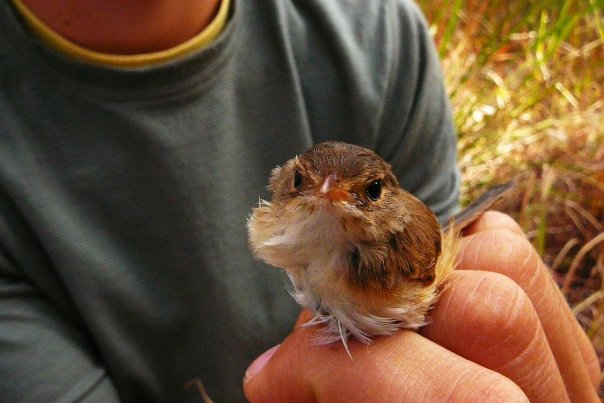
When birds leave the banding station, their physical appearance is appalling.  They have spit on their heads, their feathers are matted and in some cases, brood patches and cloacas are visible, which can be very embarrassing for individuals.  After their release, birds are forced to preen for at least five minutes in order to restore their aesthetic appearance.

It is a known fact that ugly birds have a harder time finding mates.  Thus, newly banded birds must spend more time preening and getting beautiful in order to impress prospective breeding partners.

Serious study needs to be done in this area, so at this point it is difficult to say what negative health impacts those five- to ten-minute post-banding preening sessions have on birds, but it is safe to say that it does nothing for their self-esteem.


Monday, February 20, 2012

Chickens in Distress

Remember that "Meet your Meat" film that PETA created a few years ago?  People thought, "It can't be that bad.  I'm sure most places don't treat their animals like that..."  Well, see for yourself. 

I personally took these photos at the Chase St. entrance on the SR10 going into Athens.  These chickens have arrived from Texas and are being delivered to a distributing plant in Athens, GA where they're "processed", divvied up and distributed to grocery stores.

I've been meaning to get some photos of these trucks for some time.  I often find dead chickens on the road that have fallen out.  Many of them on board are squashed and have broken legs.  I personally can't eat something that's suffered like this. 

The chicken at the top left has been crushed.  His feet are dangling out of the wire cage because either he's dead, or so weak he can't sit up.
This truck came all the way from Texas.  Long ride, especially when you're squashed among hundreds of other passengers

Sunday, February 19, 2012

Beep.

Beep. 

Beep. 

Beep. 

Beep.

The radio receiver emits a series of steady pulses against a static background.  0.719 is sitting in a large Water Oak among twelve other Rusty Blackbirds.  The oaks surround a man-made pond, in a man-made environment consisting of two houses nestled on an open field, dotted with tall oaks and Loblolly Pines.  The birds sing together and sound like the turning hinges of an old iron gate.  Is their name derived from this sound?  Or is it inspired by the rust-colored feathers the males sport during the winter months?  Perhaps both.
Can you spot the RUBLs? 

Rusties like to be near water.  They largely depend on wetlands for their food during the winter months.  Invertebrates including insect larvae and worms, and vertebrates including minnows and the odd salamander, all high in protein, make up a large part of their diet.  When it gets cold or wet, the Rusties move into residential areas to eat pecans and acorns, which are higher in fat.

Over the last few decades the Rusty Blackbird has seen a marked decline in numbers.  Their population has dwindled since the 1960s and today, biologists are scrambling to determine why.  There are a number of theories that have been developed.  Many believe the problem lies on the wintering grounds.  Pesticides, mercury poisoning, loss of habitat, and an increase in natural predators are some of the factors being looked at.   

My job as a biologist with the Polistes Foundation in conjunction with the University of Georgia is to catch these birds and attach a radio transmitter to each individual so that I can track them in order to determine what they’re doing - where they’re going, what species they’re interacting with, and what they’re eating.  This research can give us insight into their personal lives and help determine what they need during the winter months, and whether or not they're getting it.
 
0.992, a female RUBL we captured after 0.719
The natural world is getting smaller and smaller  as urban environments and agriculture spread like a pernicious virus.  It’s as true here in Athens, Georgia as it is in the Amazon.  Wetlands, like the rainforests, are succumbing to bulldozers and dump trucks.  They are being drained and filled, or choked with silt and invasive plants.  And the species that depend on these habitats are disappearing. 

But we can't simply narrow it down to disappearing wetlands.  Many Icterid species use wetlands, like Red-winged, and Yellow-headed Blackbirds and their numbers (for now) seem to be stable.  So something else is acting on the Rusty Blackbird.  Perhaps it all comes down to flexibility. 
I ponder this as I watch 0.719.  Since 7:45 AM, he has been using the same residential area along with the rest of his flock.  It is now closing in on ten o'clock.  The sky is grey and a steady, misty rain falls.  Occasionally it pours, but it doesn’t last long.  The flock moves from tree to tree, settles to the ground along with Common Grackles, strutting around, picking at nuts, seeds, insects, and worms, before taking off into the trees once more.  Sometimes they’ll sit there for half an hour, preening and singing, before taking off in a ball.  0.719 eventually flies off with his flock, north into the thick of the wetland.  I move with them.

Why don't people take us "hippies" seriously?
At the end of the day, streaked with muck, with raspberry thorns embedded in my skin, and twigs in my hair, I walk back to my car.  I fold up the antenna and drive to the Kangaroo Express to get gas (I know).  At the pump a man pulls up behind me and gets out to fill his own tank.  He gives me a funny look. 

“Playing in the mud?” he asks.   

I look down at my filthy rubber boots and laugh.  I tell him I was tracking blackbirds.  I didn't include the “Rusty” part. Few people have any idea what a Rusty Blackbird is.  Fewer know that North America is home to over 716 species of breeding birds, and nearly twenty of those are Icterids including the traditional blackbirds like Red-winged Blackbirds, grackles, and cowbirds, as well as the orioles and meadowlarks.   

“Why would you bother doing that?” He presses.   Bother?  I silently scoff at his choice of words.   

I tell him they’re declining.  

“Like, endangered?” He asks.   

“Soon,” I reply,  “if nothing is done to help”.  

He laughed.  “Now, why would we want to keep a blackbird around?”  

I honestly didn’t know how to answer this question.  Not for lack of reasons.  I've tried many times to explain to the typical ignoramus who argued that "if you can't eat it, why keep it" that a world rich in biodiversity is a good thing.  There are many reasons why we should work to keep our many neighboring species around, but people on their way home from work don't like to stick around listening to a hippie blather on about why the planet needs saving.  

So, I simply said, “Why not?”

0.719 preparing to roost

Friday, February 10, 2012

Wait... And See.


The sky is gray
Some droplets fall
But fail to dampen our spirits
While every wintering bird
Comes to call
Yet in all this wet and gray
The RUBLs remain MIA
So, the Sapsuckers stick
To their chosen trunks, like paper clips
To a magnet
They scoot and tap their way
Up!
Until there is no bark left to inspect
And off they fly, away from my eye
For I can only see to the four corners
Of this small, car window
The Crows approach now
Closer, drawn by our yellow corn and egg bait
But they know something is awry
They want it so much, but
They keep their black-feathered distance
Shuffling, too smart for their own good
Curious and afraid
Eventually their fear takes them
Away!
Cackling and screeching, one to the other
The Blue Jays harass their nemesis birds
Brilliant and red
One moment perched and the next
Diving into the group of eight scarlet crests
Until the ball scatters among the mistle toe shrubs
The jay stands proudly in the center of the shadow
Of his own making
What do I feel for the shuffling doves
As they bob their small, smooth beige heads forward
Their blue spectacled eyes fall onto nothing
But only those things edible
With only one thing in mind,
The Mourning Doves do not flinch
At every sound
Or movement
Like the crows, blackbirds, and jays
Waddling fervently inside their flock they
Peck and pick and prattle and coo
And then, for no apparent reason at all
Up into the tall pecans
They wait
I hear the sinister ‘dee-dee-dee’s
Of the tiny forest punks
Those small, feathered yobs
Remind me of a roving gang of mischievous children
And as their acronym suggests
They are off caching bits of our bait
To ensure
On warmer winter days
Full bellies on the cold, wet grays
Alas, the brown-headed squeaky toys have arrived
In the late morning light
They brighten the wait
Their upturned bills tip downward
Toward the earth
My gaze snaps up
Into the bare branches
As the wet “chup” of the Myrtle Warbler
Pierces the cool air of this old
Pecan grove

From seven on, I did wait
And at eleven ‘o’ eight, the Starlings bold
They see the bait
But no one told
The Rusty Blackbirds, no
They do not show
Where would they be now?
We simply don’t know


Wednesday, January 11, 2012

Darling Starlings and the Invisible Blackbird

The weather is warm here in Athens, GA.  It's warm up in South Carolina too, for that matter.  So, the Rusty Blackbirds are spending their days gorging themselves on earthworms, unaware of the scrumptious feast of pecans we've prepared for them in the yards of strangers in the suburbs of Athens proper.  Pecans are full of body-warming fat and Rusties love to eat them when it gets cold.  An earthworm just doesn't put on the pounds like a big old fatty pecan.  But each day and night since January 4th has been mild and lovely.  Not conducive to trapping a Rusty Blackbird.  So instead we bait historically-visited sites around the city, and wait for the weather to cool...
Sturnus vulgaris (How appropriate!)


"Whatcha lookin' for?" two women walking their yappy Pomeranians query me as I make my way around Conestee Lake Nature Reserve in Greenville, South Carolina.  "Oh, them brown birds what set on my lawn in the hundreds 'n eat all ma seed meant for the pretty red birds?!" is their reply when I tell them that I'm looking for Rusty Blackbirds.

I correct them saying that, no, while RUBLs may accompany an enormous flock of Common Grackles on the lawns of poor unfortunate birdists, they actually spend most of their time in wetlands, consuming worms and the like.  They enjoy pecans and acorns (and the occasional sunflower seed) to supplement their diet of invertebrates.  I neglect to add that the wetlands where North America's fastest declining species spends most of its time have mostly been converted to agricultural fields.  (Reduced by 85%, roughly, since we witch-burning, slave-making Europeans landed here so many years ago).
 There are a few theories floating around as to why the RUBL is losing it's footing but nothing quite explains the 95% decrease in numbers since the 1960s.

The two ladies lose interest in me immediately and disappear down the path with their fuzzy vermin choking themselves at the ends of their leashes. I continue with my task at hand: hiding three radio-transmitters that we each triangulate to make sure our sense of direction is precise.  We want to be on-target when searching for an actual blackbird.  I didn't bother mentioning this to the dog-walkers - that our small crew of three are also making the most of these Rusty-free days by testing our field equipment, and practicing our collection of biological data on species that will eat our pecans...

One hundred and twenty years ago the pesky Europeans did more than clog up precious wetlands in order to produce rows upon rows of corn, beans, and cotton.  They missed home so much they decided to bring a small part of it to North America - 80 parts of it to be exact.  In the spring of 1890 the Acclimatization Society released a swarm of starlings to Central Park in New York City.  You know the ones I'm talking about.  They whine and sing outside your window in the morning and murmurations, or flocks, of their oily iridescent black-and-speckled bodies can be seen wafting through the city sky around dusk.

Not only are they prolific but they like to nest in cavities, just like a lot of native species like woodpeckers and wrens.  There are so many starlings and so few holes.  The native species usually lose out in the end.  No nest for Mr and Mrs Woodpecker means no babies to perpetuate the family name.

A day later, after learning we need to order new telemetry radios, I can't help but forget about my contempt for this introduced and invasive species as it focuses it's deep brown eyes on my approaching hand.  Their hardiness helps explain their impressive ability to colonize the entire continent, and it makes them the perfect model to practice our morphometric data-collection and biological sample extraction.

Poke, bleed, blot, hold, clip, pluck, wing!tail!tarsus!bill-length!-depth!-width!fatscore!

Two and a half hours and twenty starlings later we're done.  The starlings were a little sore about the whole episode, but now, we are sharp.  And we are more than ready to get our expert hands on some brown birds what set on yer lawn 'n eat all yer 'spensive sunflower seeds, or so they call them.

Wednesday, October 26, 2011

field gems

March 29, 2011

We finished-up by 1 in the afternoon but the day had been eventful, and was far from easy.  A few days prior, our boss's adviser made a last-minute decision:  in addition to our present workload, we would begin collecting vegetation data for Golden-winged Warblers banded in previous years. We had only a few weeks left to finish up the field project, and so we had to haul some ass, so to speak.

The three of us set off  on a familiar trail towards Tonio's finca (farm) to conduct eight vegetation surveys.  Last year, two male golden-wings were detected up in the hills we were strolling around in.  According to the field protocol, four points are needed for each bird's territory.  The first point at which we record vegetation data is where the bird was detected.  From this hub three more points, 50 meters away, at 0, 120, and 240 degrees are surveyed. 

So, we knew where we had to go, but, like most of our study sites, our destination lay deep within the confines of pre-montane rainforest.  The majority of our "veg-points" required busting serious ass (so to speak) through primary and secondary forest - spelled Thick, Spiny, Dense, and Vine-y.
Cypress takes a GPS point next to one of the largest trees we had to measure
GPS in hand, Cypress led us to the first four points, Jeffe took us to 5 and 6, and I finished things up at the last two.  We slipped through greasy mud, and whacked and crashed through tall, wet grass, vine tangles, slicing our machetes through small trees and brambles.  Small bleeding cuts appeared on exposed hands and arms, and occassionally, legs were impaled on small sticks jutting out of the damp earth.  The entire time we were accompanied by a horsefly or two (or three, or four), excellent company to our misery.
Cypress and Jeffe disappear behind a wall of vegetation 
We measured canopy height, percent cover, and the number of vine tangles (goldies love to forage in them).  Then we measured the diameter-at-breast height (dbh) of all the trees we spied through our yellow-tinted prism.  Last, we classified the area as primary or secondary forest.  We moved on to our next point.

When we finished all eight points Jeffe led us out of the thick of the forest, back to the main trail that would take us back down the hill and to our field vehicle.  We had back-tracked nearly thirty meters when all of the sudden Jeffe emitted a cry,

"Yeeeoooowwwww!"

We all stopped dead in our tracks.

"What?!"  We cried back, hearts pounding.

"A snake!"  Jeffe replied, breathless. 

We pried our heads over one another, craning our necks to look in the direction of our boss's trembling gesture.  And laying there, curled next to a log, was a Fer-de-Lance. 
Property of www.hidephotography.com
Most herpetological textbooks label this large viper as the most dangerous snake in Central America.  But belying its malignant reputation, the snake sat motionless and peered at us over the plump, green coil of it's body.  It flicked its tongue in our direction, surely catching a whiff of our fear and curiosity.  We took advantage of this rare opportunity (rare in the sense that we weren't being lunged at) and snapped a few photos of the beast, who had probably just eaten something which explained why it didn't move.

After the boys were finished poking and prodding the snake with the tips of very long sticks, and thus satisfied that the snake wasn't going to come after us, we hurried along the rest of the way, silently wondering at how many other vipers we had unknowingly brushed past.  We found an open path that eventually led us to the main road.  We paused near the end of the trail and focused our binoculars on a pair of White Hawks, that in turn, eyed us suspiciously as they perched high in a tree.  They soon returned their twin gazes toward the grass, searching for prey, and we took our leave. 
A bad photo of a beautiful bird:  The White Hawk
"Caballo Blanco", our 1995 Nissan Pathfinder, was waiting for us at the bottom of the hill. Our bones aching, and our foreheads dotted with beads of sweat, we clambored into the truck and headed home.  As we bumped and shifted over the white rubble of Cedral's main roads, I tried to absorb the sights that I had taken for granted so many times before.  The colourful houses, the blossoming trees, even the preotective dog choking itself at the end of its chain. 
A Capuchin Monkey gives us a quick view before he too
disappears into the thick of the forest
My time here was drawing to a close.  Only two weeks remained and soon Cypress and I would find ourselves on the other side of the world.  I wanted to remember this place, and lock it away.  Although the work was hard, and the snake encounter had left me a little weak in the knees, I was happy for the adrenaline rush.